Sana – Human-Centered AI Chatbot Concept
Designing trust, clarity and guided support for natural health decisions.
SANA explores how conversational AI can support people in navigating natural health questions with more clarity, calmness and confidence. Developed as part of Stanford’s “UI/UX Design for AI Products”, the concept focuses on trust, tone of voice and guided support in a sensitive health context.
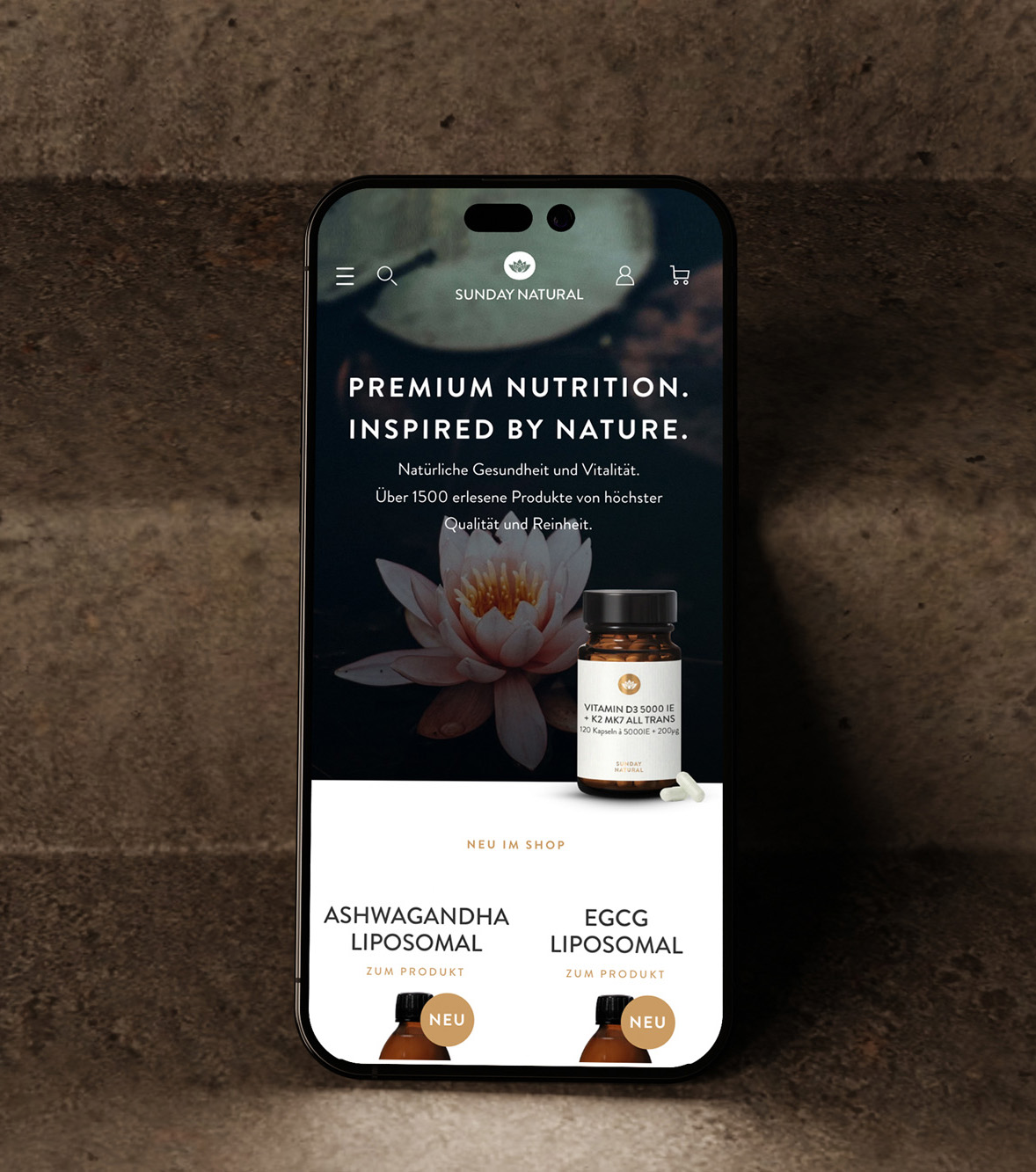
Good AI should make people feel more capable
SANA is a human centered AI chatbot concept for Sunday Natural. It explores how AI can become a calm and supportive layer inside a natural health experience.
The goal was not to create a chatbot that simply answers questions. The goal was to design an AI experience that helps people feel understood before they receive guidance.
In a category where people often search for support around sleep, energy, hormonal balance, gut health or immune function, the experience needs to do more than deliver information. It needs to create orientation, confidence and a clear next step.
The Challenge
Health decisions are personal
People often arrive with uncertainty. They may know how they want to feel, but not what really matters, how different symptoms connect or which information is relevant for their situation.
At the same time, AI in health related contexts can quickly become problematic. If it sounds too confident, it feels unsafe. If it stays too vague, it is not useful. If it behaves like a sales assistant, trust disappears.
The challenge was to design an AI assistant that could guide people through complex information without overpromising, overwhelming or taking control away from them.
My goal was to design an AI-powered experience that brings clarity, trust, and empathy to this decision process.
Core Question
How can AI give meaningful guidance while still feeling transparent, human and safe?
Insights
People do not trust recommendations before they feel understood
In natural health, users are rarely looking for isolated facts. They want the bigger picture. Their goals, symptoms, lifestyle, preferences and level of uncertainty all matter.
This is where AI can create real value. Not by replacing human judgment, but by connecting information, recognizing patterns and helping users make sense of complexity in a calmer, more structured way.
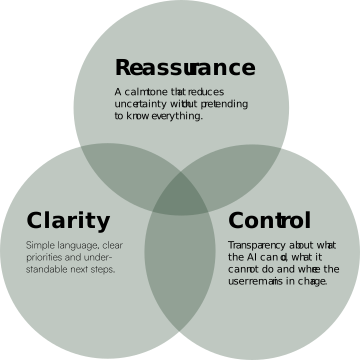
For SANA, trust had to be designed on three levels: clarity in the information, reassurance in the tone and control in the interaction. These needs became the emotional foundation for the assistant and guided the conversation logic, tone of voice and visual direction.
User Trust Model
Trust grows when people feel clear, reassured and in control
Design Strategy
Trust before recommendation
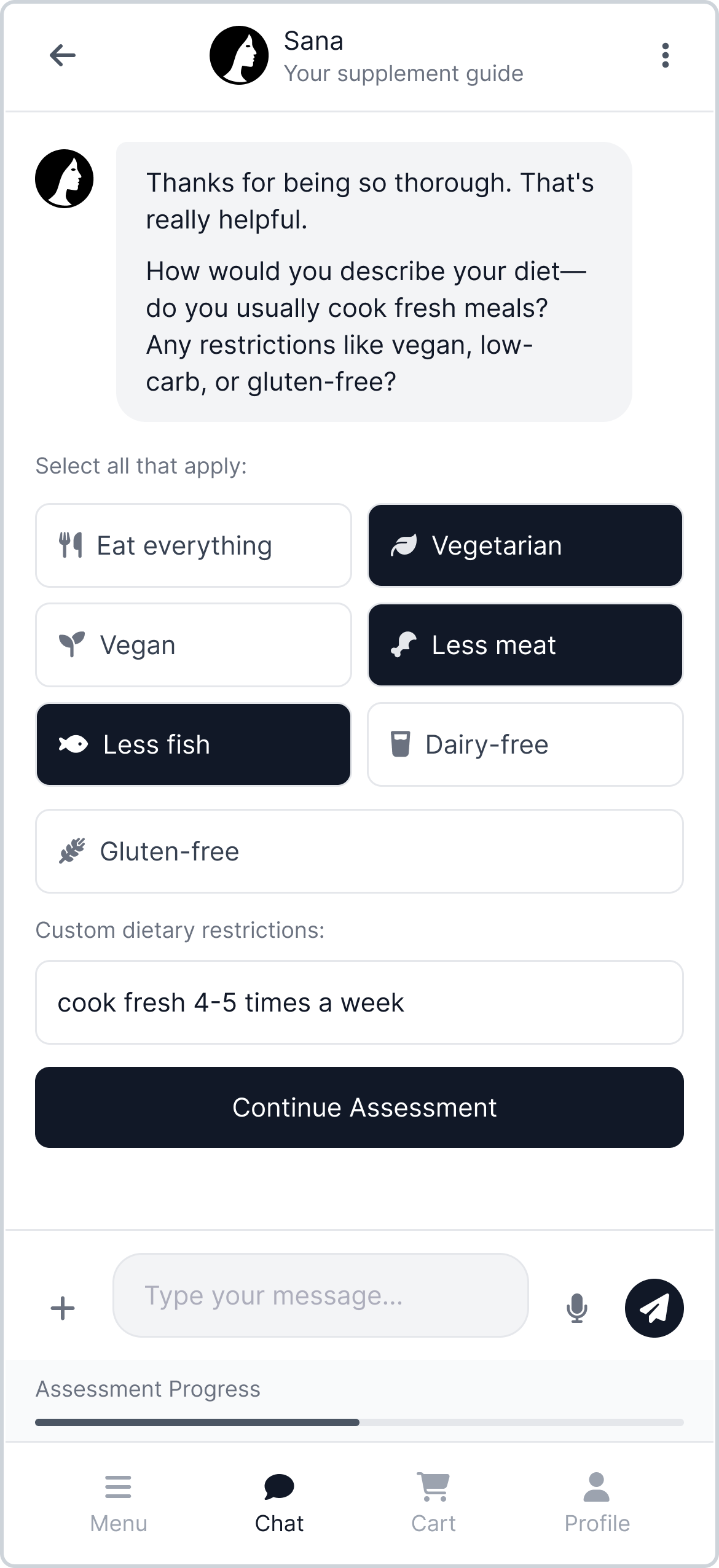
I designed SANA around a guided conversation model that first builds understanding before offering guidance. Instead of expecting users to write perfect prompts, the experience helps them enter the topic through simple choices, calm questions and contextual follow ups.
The assistant adapts to different levels of confidence. Some users need guidance and reassurance. Others already know what they are looking for and want direct support. Both should feel helped without being forced into the same path.
UNDERSTAND
SANA first explores what the user is looking for, what context matters and how confident they already feel.
User feeling
“I feel seen before I am advised.”
EXPLAIN
The assistant makes its reasoning understandable in simple language, so recommendations do not feel like a black box.
User feeling
“I understand why this matters.”
SUPPORT
The experience gives calm, structured guidance and helps users move toward a clear next step.
User feeling
“I know what I can do next.”
PROTECT
The assistant communicates limits, avoids false certainty and keeps the user in control.
User feeling
“I feel safe and still in charge.”
Execution
A calm guide that listens before it advises
SANA, derived from the Latin sanare, meaning “to heal”, was designed as a trusted guide rather than a typical chatbot.
I developed the name, logo, visual identity, tone of voice and conversation logic as one connected AI experience. The goal was to make health guidance feel human, trustworthy and easy to navigate.
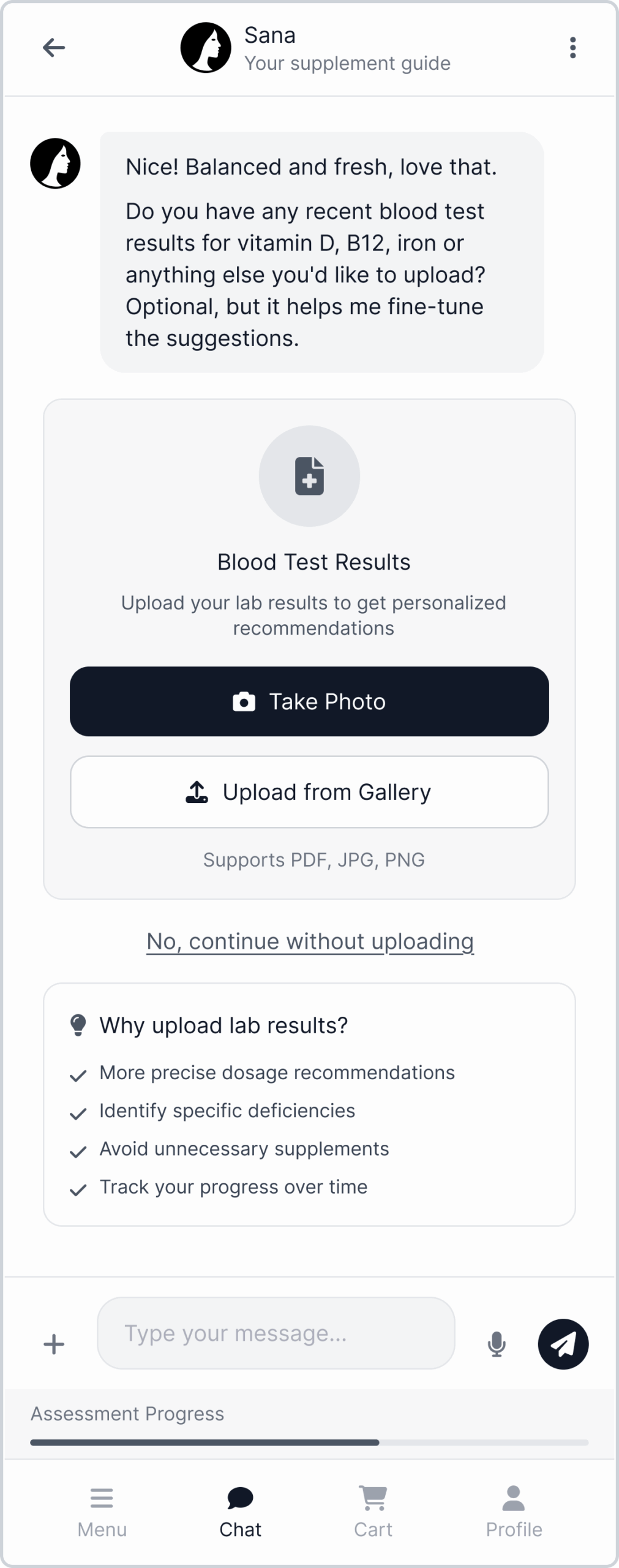
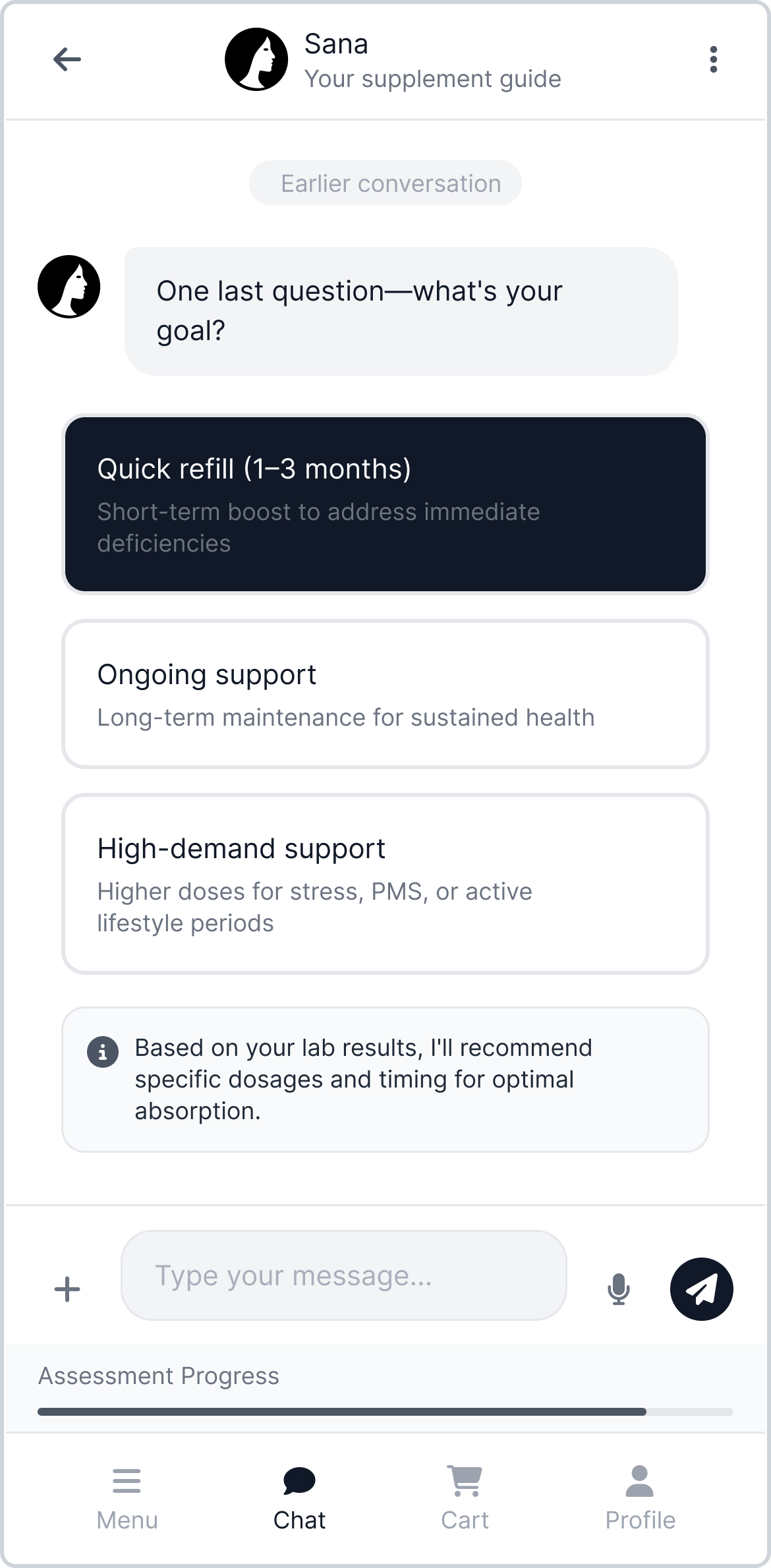
The system accepts different types of personal context, from symptoms and goals to diet preferences, conditions, medication or lab results. Instead of forcing everyone into the same flow, SANA adapts around the user’s input and asks only what is needed to create clarity.


AI Quality Guardrails
Trust needs boundaries.
No false certainty
No medical diagnosis
No pressure to buy
Clear limits around health advice
Transparent explanations
Human judgment stays central
Outcome
From information to orientation.
SANA shows how AI can become a meaningful support layer inside a wellness brand without making the experience feel generic, automated or transactional.
The concept combines conversational guidance, tone of voice, trust principles, flexible input and a clear interaction model to help users move from uncertainty toward a more confident next step.
“Sana is a perfect fit for Sunday Natural. The tone is direct and accessible and the conversation is geared toward resolving real user questions. You applied the chatbot model well to a specific need.”
Instructor Feedback: Luis García Maillo, Stanford Online

Reflection
This project strengthened my belief that designing for AI is ultimately designing for people. The intelligence of a system is not measured by the amount of data it processes, but by the quality of the relationship it creates.
Good UX makes technology feel simple. Great UX makes it feel human.
Working on SANA allowed me to combine emotional design with structured logic and explore how brand identity can extend into conversational behaviour. It is one of the aspects of AI design that I find most inspiring.